Car Lift Damage or Faults: From Stop-Use to Return to Service
When damage or a fault raises doubt about a lift’s safety, stop routine use and follow the supplied fault instructions with qualified assistance. For workshop buyers and managers, BH-900 and BH-34T illustrate how equipment identity, incident reporting and a clear service-status decision fit together.
Key takeaways
• A current inspection report does not establish the condition of equipment after a new fault or impact.
• Record what happened without treating an operator’s observation as a repair diagnosis.
• Identify the complete supplied configuration, especially when a mobile-column set has several units.
• Agree repair, assessment and return-to-service responsibilities before purchasing the lift.
1. Stop routine use when safety is in doubt
If damage or a fault raises doubt about safe operation, stop routine use and notify the responsible workshop manager. Follow the supplied emergency and fault instructions; if a vehicle remains raised, keep people away from the hazard and obtain qualified assistance. Do not improvise lowering, support or recovery.
HSE’s maintenance guidance says faulty or damaged equipment should not be used and maintenance must be performed by competent people under a planned safe system. It also addresses hazardous energy and unintended movement. Switching off a control is not, by itself, a complete maintenance safety plan.
Before buying, agree how the workshop will prevent unauthorized use while a fault is unresolved. The supplier and qualified service provider need to define the applicable procedure for the actual model, rather than an operator inventing one during a breakdown.
2. Describe the observation before guessing the cause
A useful fault report separates three things: what the operator observed, the circumstances when it appeared, and the qualified provider’s eventual diagnosis. This proposed reporting method helps avoid ordering a part merely because it resembles the visible symptom.
For example, “movement stopped and the displayed message was X” is a more precise observation than “the motor has failed.” Record an actual message exactly; X here is only a placeholder, not a claimed EHRLE fault code. Include whether a vehicle was present and the equipment position when the issue arose.
Capture identification and photographs only from a safe location. Do not reproduce the fault with a vehicle, enter beneath an uncertain load or dismantle equipment to improve the report. The installed manual and qualified provider determine the investigation.
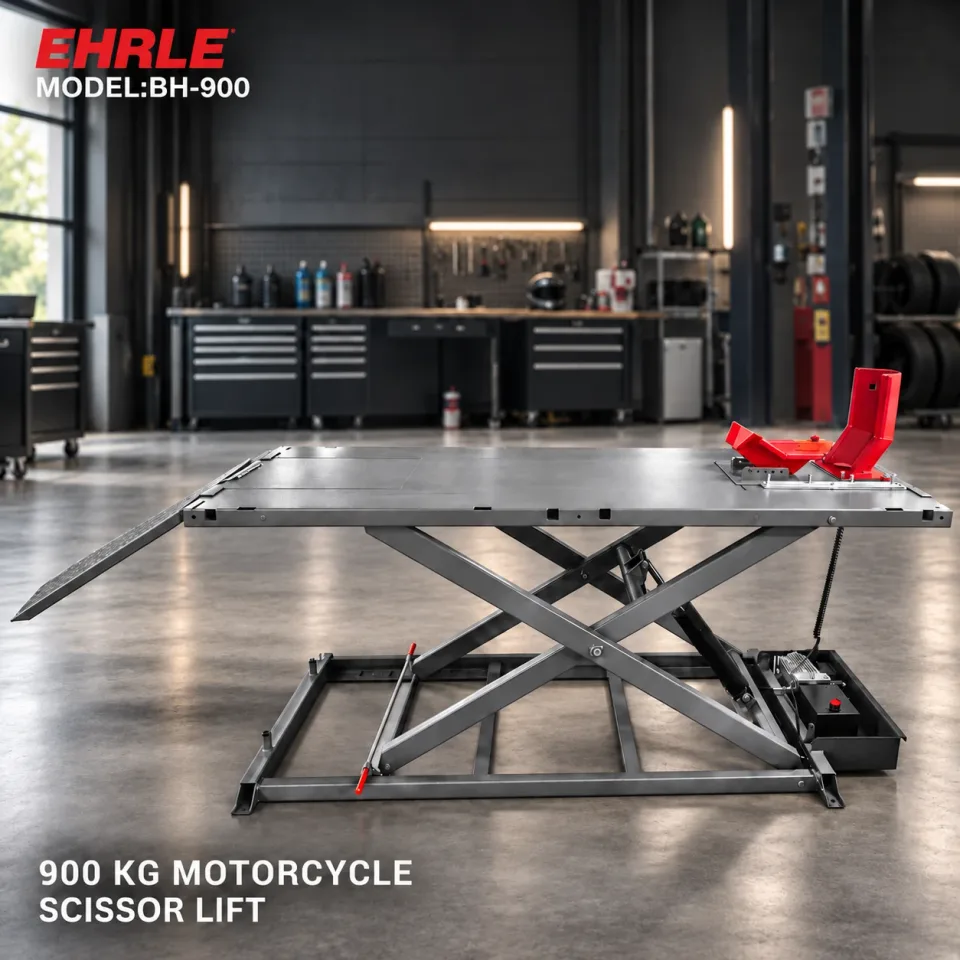
3. BH-900: identify the motorcycle table and securing arrangement
The current BH-900 record describes a 900 kg motorcycle table with a front wheel chock and loading ramp. Its working platform measures 2,232 × 750 mm, and its listed minimum and lifting heights are 190 mm and 1,200 mm. These identify the documented version; they are not damage-acceptance limits.
A hypothetical report about damage around the chock should identify the supplied chock and securing equipment, the motorcycle and the service task. The product record states that the chock alone is not a universal restraint. A photograph of the table without a motorcycle cannot establish that a particular securing arrangement remains suitable.
Keep this narrow 900 kg table distinct from the separately described widened 1,300 kg tricycle equipment. Replacement-component approval must match the installed version. This article supplies no chock repair, welding, strap-rating or motorcycle recovery procedure.
4. BH-34T: a fault report needs the column-set identity
The BH-34T record lists a standard four-column wheel-engaging system, rated at 8,500 kg per column and 34,000 kg combined. It uses wireless communication and rechargeable 24 V operation, with AC 220 V charging. Six- or eight-column arrangements require an approved configuration.
For a hypothetical fault involving one column, record that unit’s identification and its relationship to the complete operating set. Include the actual column count and configuration so the provider can assess the report in the correct system context. This is a proposed information package, not a statement about any particular BH-34T failure mode.
Do not treat the combined capacity as permission to remove a suspect column, mix an unapproved replacement into the set or continue with fewer supports. The catalogue establishes neither such an operating mode nor a fault-reset procedure. The qualified provider needs the supplied control and operating documentation.
5. An earlier inspection does not resolve a later incident
An inspection report describes an examination at a particular time. It cannot account for damage that happened afterward. Likewise, a repair invoice identifies work performed; it does not automatically establish that all required assessment and release steps are complete.
For Great Britain, HSE’s lifting-equipment guidance identifies damage, failure and certain major changes as circumstances that may trigger examination outside the regular schedule. It also distinguishes immediately dangerous defects from findings with a specified remedy deadline. These are jurisdiction-specific provisions, not a universal EHRLE inspection interval.
Have the responsible qualified parties determine the assessment required for the actual incident, equipment and destination rules. Do not substitute an improvised overload test or a successful empty cycle for that decision. HSE notes that testing is not automatically required for every examination and inappropriate overload testing can itself cause damage.
6. Close the fault with an explicit service-status decision
Before the lift returns to routine work, the workshop needs a clear decision about its permitted service status under the applicable instructions and requirements. Agree who can make that decision, what assessment is needed and how operators will receive the result.
A practical workshop record can link the original observation, equipment identity, qualified diagnosis, approved work and parts, assessment results and any remaining restrictions. This is a suggested record structure; it does not claim to replace a prescribed report or certify the machine.
For procurement, ask how technical queries and replacement-part identification will be handled for the ordered version. Do not assume a specific response time, local service network or parts availability unless the quotation expressly establishes it.
A pre-order fault-response checklist
Agree:
1. Exact model, supplied configuration and equipment identification.
2. Operator fault-reporting and emergency instructions.
3. Who arranges qualified diagnosis, repair and any further examination.
4. How approved parts and configuration changes are identified.
5. Who determines and records permission to return to routine service.
For a BH-900 motorcycle bay or a BH-34T heavy-vehicle installation, send EHRLE the intended use, destination and required document scope with your enquiry. For an installed machine, include its identification and existing instructions. Defining responsibilities before delivery makes the response to a later fault clearer.
Frequently asked questions
Can the lift continue working because its last inspection is still current?
A previous report does not resolve a newly identified fault or incident. Stop routine use where safety is in doubt and obtain the required assessment.
Does fitting a replacement part automatically clear the lift for use?
No. Confirm the part approval, work completed and any assessment or release required for the actual equipment and incident.
Can a BH-34T set continue after one suspect column is removed?
That operating arrangement is not established by the current record. Do not derive a reduced-column configuration from the capacity figures.
Does this guide set a universal inspection deadline?
No. Model instructions, the condition and history of the equipment, qualified assessment and applicable destination requirements determine the necessary actions.
Sources and image notes
EHRLE BH-900 and BH-34T published, enabled and verified records were checked on 10 November 2026. Their related pages appear below. Primary external references: HSE, Maintenance of work equipment, and Thorough examinations and inspections of lifting equipment, at hse.gov.uk. The first supports competent maintenance and control of maintenance hazards; the second supports post-incident examination, defect handling and the distinction between examination and testing. The legal discussion is limited to Great Britain and does not assign a worldwide examination schedule.
Cover and gallery are existing product scene illustrations, not photographs of a fault, customer repair or inspection. The chock-damage and single-column-fault examples are hypothetical. No model-specific fault, repair limit or service procedure is inferred from these images.
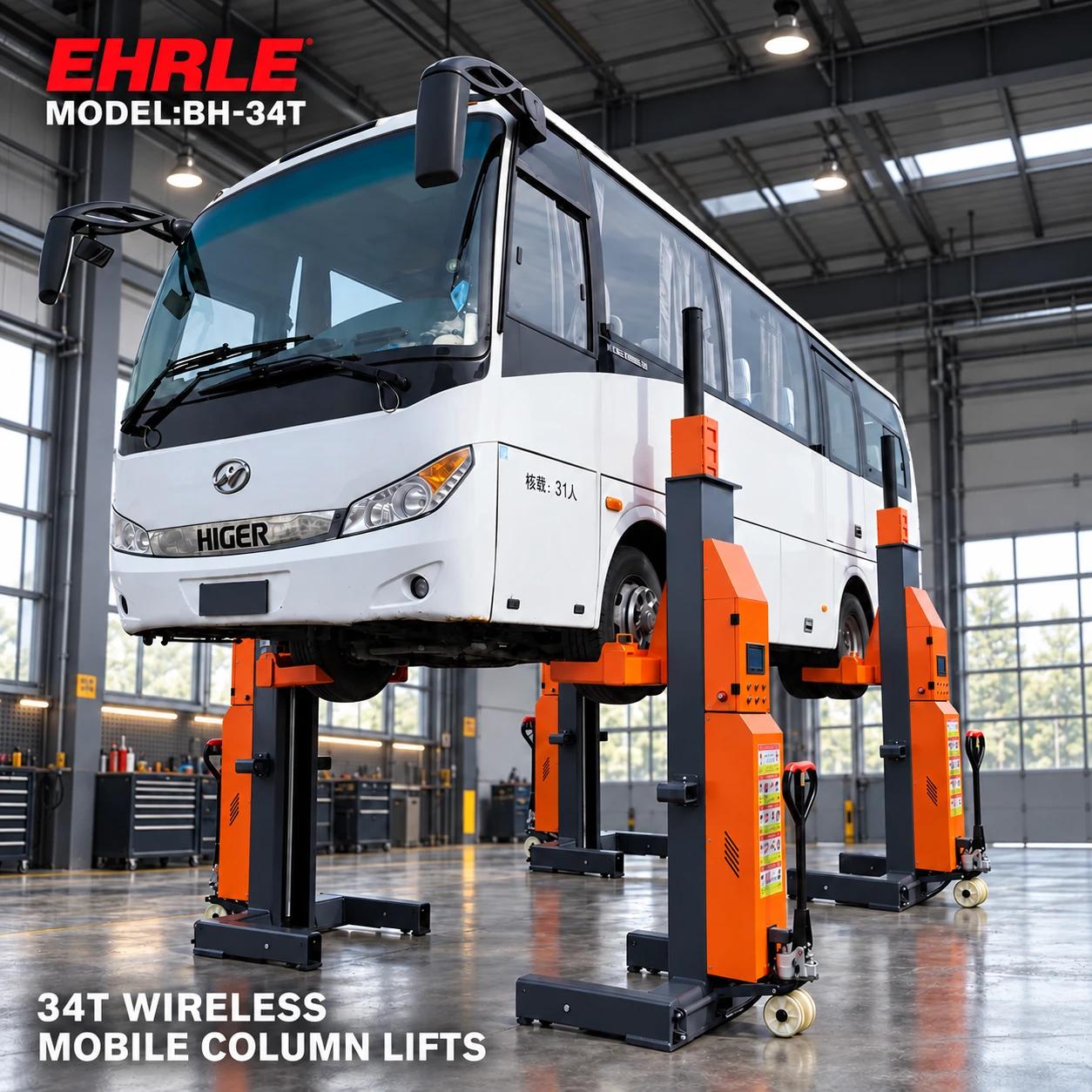
Product scene illustration. No customer incident, repair result or approved fault-recovery procedure is depicted.