Choosing a Lift for EV Service: Capacity, Lifting Points and Battery Clearance
Assess EC500 and 6016 as candidates for EV service using vehicle-specific lifting points, support geometry and task requirements—not lifting capacity alone.
Start with a vehicle list and a defined service task
An electric-vehicle service bay needs a compatibility assessment for the actual vehicles and the intended work. A lift capacity higher than vehicle mass is only the first screening condition. The approved support points, permitted load distribution, arm or platform geometry and access to the work area must also agree.
Separate routine wheel, brake or underbody service from battery removal when writing the enquiry. Approval for one task does not establish approval for the other. This guide concerns purchasing evidence and does not provide an operating procedure or a vehicle-specific lifting approval.
Use current vehicle lifting-point information
The Automotive Lift Institute’s January 2026 guide announcement explains that frame-engaging lifts need appropriate adapters at the vehicle manufacturer’s specified lifting points. It also notes that lifting points can change with model year and that current information replaces earlier editions. Its guide covers relevant vehicles sold in the United States and Canada; buyers elsewhere should obtain applicable OEM information for their own vehicles.
Source: https://www.autolift.org/news/2026-ali-lifting-points-guide-eliminates-guesswork-for-safer-vehicle-lifting/
For procurement, identify make, model, model year and relevant variant, then attach the applicable OEM lifting diagram. A generic EV label, an unrelated vehicle photograph or a previous model-year diagram cannot substitute for that evidence. This source is general lifting guidance, not certification of either EHRLE model discussed here.
EC500: assess arm reach and pad access after the 5,000 kg screen
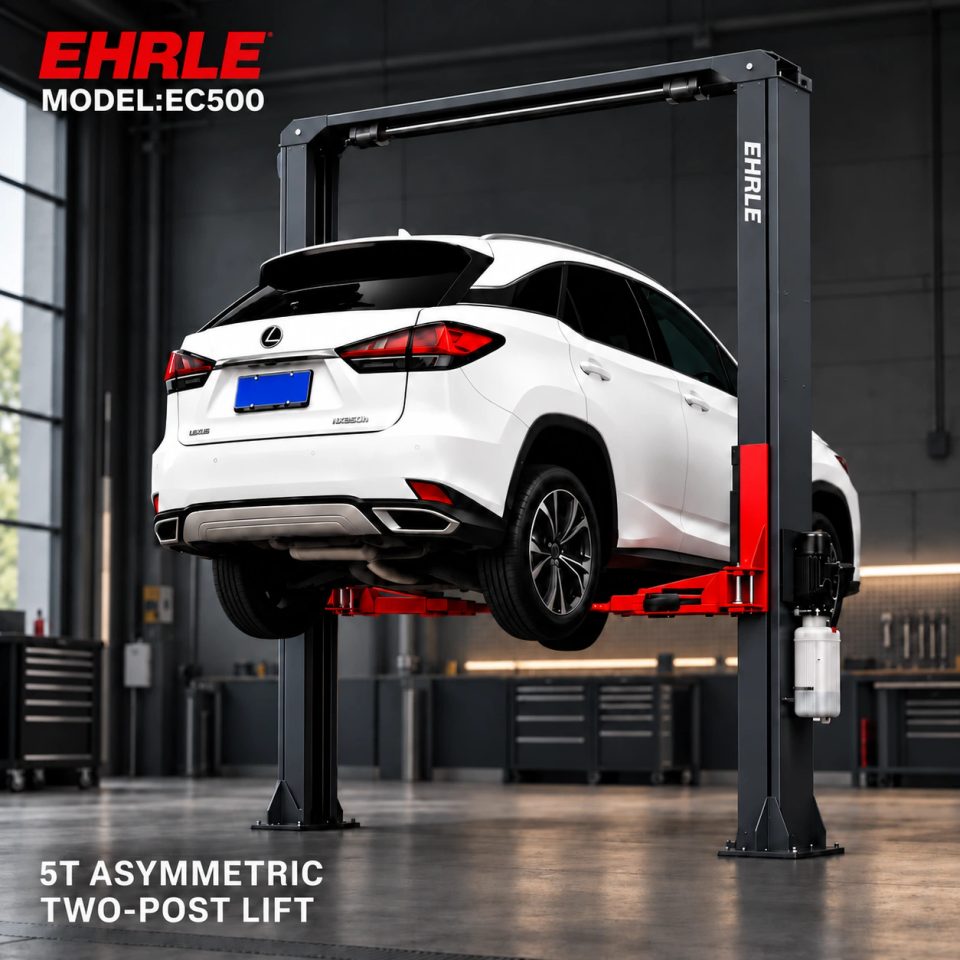
The current EHRLE EC500 record lists a 5,000 kg overhead two-post lift with 90 mm minimum height and 1,800 mm maximum lifting height. Its application notes include EVs and hybrids as potential categories for assessment, with particular attention to pad access around low bodies and battery housings. These are conditional applications, not approval for every electric vehicle.
The 90 mm figure does not describe every arm, adapter and vehicle combination. Request the selected arm-reach drawing, pad and adapter dimensions, permitted load-distribution information and compatibility review against the actual OEM support points. Check that the proposed arrangement can reach those points without unintended contact with surrounding underbody components. The current record does not provide an approved EV adapter catalogue or a universal battery-clearance measurement.
6016: check support geometry and the area needed for the job
The 6016 is a 3,500 kg surface-mounted full-rise double-scissor lift with twin short platforms and hinged end sections. Its listed applications include compatible wheel-free tire, brake, suspension and underbody service. The platform, pads and approved lifting points must fit one another, while the support arrangement must leave access to the intended work area.
The current product record does not establish a particular EV fit. It also does not provide verified numerical platform dimensions or maximum and minimum heights. Obtain these for the quoted configuration before comparing its support envelope with a vehicle. Do not transfer the EC500’s 90 mm minimum height to the 6016 or assume the platform shape clears every underfloor battery housing.
Compare the support arrangement, not just 5T versus 3.5T
For the EC500, the purchasing review focuses on the individual arms, pads and their reach to the approved points. For the 6016, it focuses on the twin platform envelope, contact-pad arrangement and the access left around those platforms. Their 5,000 kg and 3,500 kg ratings do not establish which is suitable for a particular EV or service job.
A vehicle below both ratings can still have an incompatible support geometry. Conversely, choosing the larger nominal rating does not answer whether the adapters, permitted vehicle position and work access are appropriate. Ask the supplier to review the same vehicle list and task description for each proposed configuration.
Treat battery removal as a separate scope decision
Neither product record reviewed for this article establishes a complete battery-removal system, an approved battery-support table package or a vehicle-specific battery-removal procedure. A quotation for a vehicle lift should therefore not be treated as a quotation for all equipment required for battery work.
If battery removal is planned, obtain the vehicle manufacturer’s applicable service procedure and ask qualified personnel to assess the vehicle support arrangement, component-support equipment, access and task-specific requirements together. Any change in supported vehicle condition needs its own assessment under the relevant instructions. Do not extrapolate a routine-service lift approval into permission to remove a battery.
Put the compatibility evidence into the quotation
Send the following with an EV-service enquiry:
1. Vehicle make, model year, variant, actual relevant weights and OEM lifting-point documents.
2. The intended jobs, distinguishing routine service from battery-related component removal.
3. Underbody and support-point dimensions needed to assess pad access and surrounding clearance.
4. For EC500, the proposed arm and adapter package; for 6016, the platform and contact-pad arrangement.
5. A measured bay plan, ceiling obstructions and electrical supply details.
Request the supplier’s documented compatibility assessment, selected configuration drawing, permitted load-distribution guidance, accessory identification and applicable operating and installation instructions. Resolve missing dimensions before ordering. Foundation, anchor, torque and electrical connection requirements must come from the supplied model’s documents and be assessed by the qualified installer for the actual site.
Contact EHRLE with this vehicle-and-task brief to discuss EC500 or 6016 as candidates. The next useful result is an evidence-backed configuration review, rather than an unsupported promise that one lift fits all EVs.
FAQ: Is a 5T two-post lift automatically suitable for every EV under 5T?
No. Capacity is one condition. The actual vehicle must also meet the permitted load-distribution, support-point, arm-reach, adapter and clearance requirements of the selected arrangement. The EC500 record lists EVs as potential applications for assessment, not a blanket fit guarantee.
FAQ: Can the same pads or adapters be used for all electric vehicles?
The current records do not establish a universal EV adapter. Specify the exact vehicle and applicable OEM support requirements, then confirm the approved interface and supplied accessory package with the lift supplier.
FAQ: Does wheel-free access mean the lift is ready for battery removal?
It establishes neither a battery-removal package nor a task approval. Obtain the applicable OEM service procedure and a separate assessment of vehicle support, component-support equipment and working access.
Sources and image notes
EHRLE EC500 and 6016 published, enabled and verified product records were checked on 16 October 2026; the related pages are linked below. The ALI source above supplies general lifting-point guidance only. No claim of ALI certification, universal EV compatibility or an included battery-handling package is made.
The cover and gallery are product scene illustrations. The pictured vehicle is not identified or verified as an EV, and the images are not proof of a vehicle-specific support arrangement or a customer installation. Final compatibility depends on the selected equipment and the actual vehicle documents.
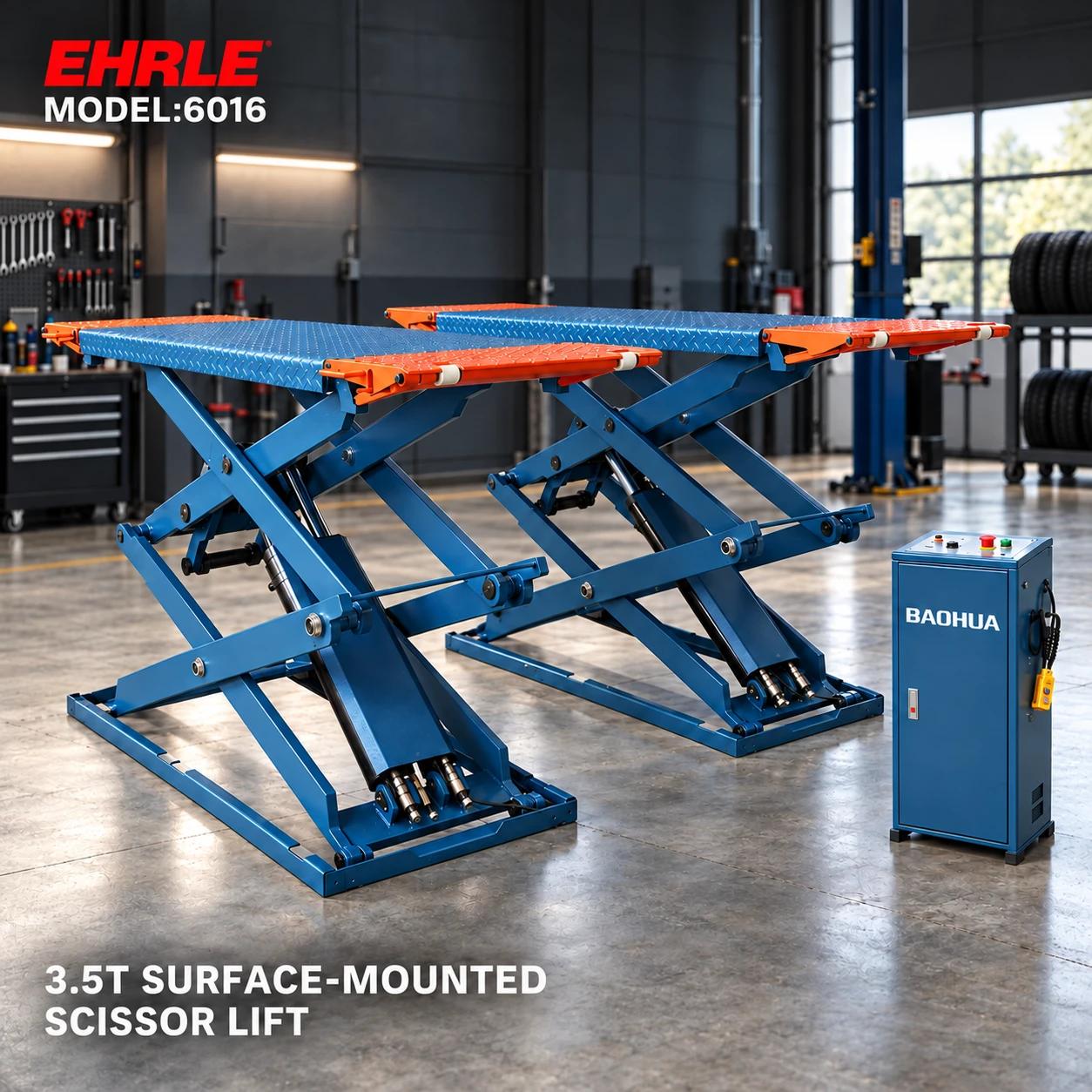
Product scene illustration. Confirm platform dimensions, pad positions and vehicle-specific support requirements before selecting this arrangement.