Low-Rise or Full-Rise Scissor Lift? Match 6010B, 6010C and 6016 to the Job
Compare 6010B and 6010C capacity, platform size and working height with the full-rise 6016 role before choosing a tire, brake or underbody service lift.
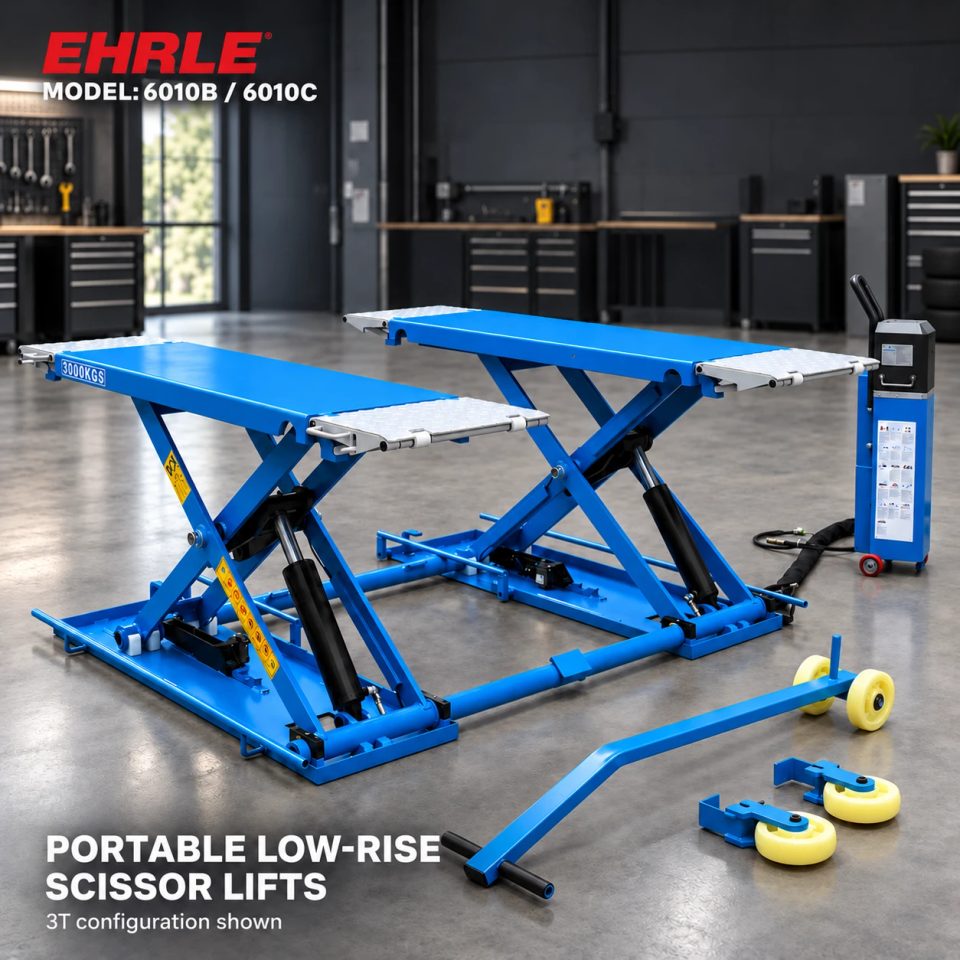
Choose the working access before choosing the larger capacity
For a tire-and-brake bay, a low-rise lift may be a candidate when the vehicle, support points and working position fit the documented arrangement. For a workshop expecting full-rise underbody access, the required work area and height need a different assessment. Choosing a larger nominal capacity does not change one service layout into the other.
The EHRLE 6010B and 6010C are documented for compatible passenger-car tire, brake and low-rise inspection tasks. The 6016 is a surface-mounted full-rise double-scissor model. Compare them against the jobs and vehicle list for the bay, rather than assuming the highest capacity is the most useful choice.
6010B and 6010C differ in more than one tonne of capacity
The 6010B lists 3,000 kg complete-lift capacity and 1,000 mm maximum lifting height. Its individual platforms are 460 mm wide, with 1,420 mm listed length or 2,028 mm with extensions. The 6010C lists 4,000 kg capacity, 1,200 mm maximum height and 530 mm platform width, with 1,570 mm length or 2,175 mm with extensions. Both list 105 mm minimum height.
These changes affect the dimensions to review with the vehicle support-point information. A wider or longer platform is not automatic approval for every heavier vehicle. Ask the supplier to confirm the usable support arrangement, pads, extension configuration and permitted load distribution for each vehicle. Neither model’s rating is a separate capacity available on each platform.
An extra 200 mm does not make the 6010C a full-rise replacement
The listed maximum-height difference between 6010C and 6010B is 200 mm. This is an equipment comparison, not a promise of a particular technician working position or clearance beneath a vehicle. The vehicle underside and the platforms’ position also affect access to the intended job.
The current application record explicitly distinguishes these low-rise lifts from full-rise underbody access. Specify which areas must be reached and the working position needed before selecting a model. Do not treat 4T capacity or a 1,200 mm maximum height as evidence that the 6010C replaces a full-rise bay for every service task.
6016: request the missing numerical dimensions for the full-rise option
The 6016 record identifies a 3,500 kg full-rise double-scissor lift with twin short platforms, hinged ends, a separate cabinet and wired pendant. Its applications include compatible tire, brake, suspension and underbody service, subject to approved support points and access around the platforms.
The current specification table does not provide verified numerical maximum/minimum heights or platform dimensions. Obtain those for the quoted configuration before approving its working access. Do not copy the 6010B/C 105 mm minimum or their platform dimensions to the 6016. Its full-rise description is useful for screening, but the actual configuration drawing must complete the assessment.
Assess repositioning as a separate workshop requirement
The 6010B/C record describes a removable mobility kit for repositioning an unloaded, fully lowered lift. This may be relevant when assessing placement between suitable work areas; it does not establish permission to move a supported vehicle. Agree the supplied mobility kit, support pads and accessory scope in the order.
Portable equipment still needs suitable floor and operating conditions at each intended position. The 6016 is documented as surface-mounted, with model-specific floor, anchoring and service-routing requirements. Do not assume it shares the 6010B/C mobility arrangement because both use short platforms. Qualified installers must review the actual site using the selected model’s instructions.
Build a task-and-vehicle schedule for the quotation
Give the supplier:
1. The intended tire, brake, suspension or underbody jobs and the areas that need access.
2. Representative vehicle models, weights, approved lifting points and pad-access concerns.
3. The working-height requirement, stated as a task need rather than an assumed equipment figure.
4. Whether the lift will stay in one bay or require unloaded repositioning between approved locations.
5. Floor and bay information, overhead obstructions, supply voltage, phase and frequency.
Request a model-specific support drawing, permitted load distribution, operating/locking positions, numerical height range and an itemized accessory list. Ask the supplier to assess each intended vehicle and identify any task that remains outside the confirmed scope. Obtain installation requirements from the exact model documents instead of borrowing concrete, anchor or electrical values from another lift.
A practical way to narrow the shortlist
Keep 6010B or 6010C on the shortlist for a low-rise service role only when the selected vehicle support and working access are confirmed. Compare the two using their actual load, platform and height differences. Investigate 6016 when full-rise access is required, while keeping its 3,500 kg rating and drawing-dependent dimensions in the decision.
Send EHRLE the task-and-vehicle schedule to request a configuration review. The useful outcome is a confirmed match between the job, support arrangement and equipment—not a claim that all three lifts are interchangeable or that one is universally better.
FAQ: Does a 4T 6010C lift higher than every 3.5T lift?
Capacity and height describe different attributes. The 6010C lists 1,200 mm maximum height, while 6016 is described as full-rise but needs its numerical height range confirmed from the selected configuration documents. Do not rank lifting height from capacity alone.
FAQ: Does 105 mm minimum height guarantee access under every low car?
No. For 6010B/C it is an equipment dimension. The vehicle’s approved lifting points, pad arrangement, body clearance and permitted support conditions still need assessment. It is not a published minimum-height value for 6016.
FAQ: Can the portable models be moved with a vehicle on them?
No. The documented repositioning arrangement is limited to an unloaded, fully lowered lift using the specified mobility equipment. It does not provide loaded vehicle transport.
Sources and image notes
This guide uses published, enabled and verified EHRLE 6010B/6010C and 6016 records checked on 19 October 2026. Related pages are linked below. It develops task, working-height and platform-size selection beyond the earlier release-system and delivery-scope articles.
The cover is a product scene illustration labelled as a 3T configuration; it is not evidence of the 4T version’s dimensions or a loaded performance demonstration. The 6016 gallery is also illustrative. Neither image is a scaled installation drawing or customer installation photograph.
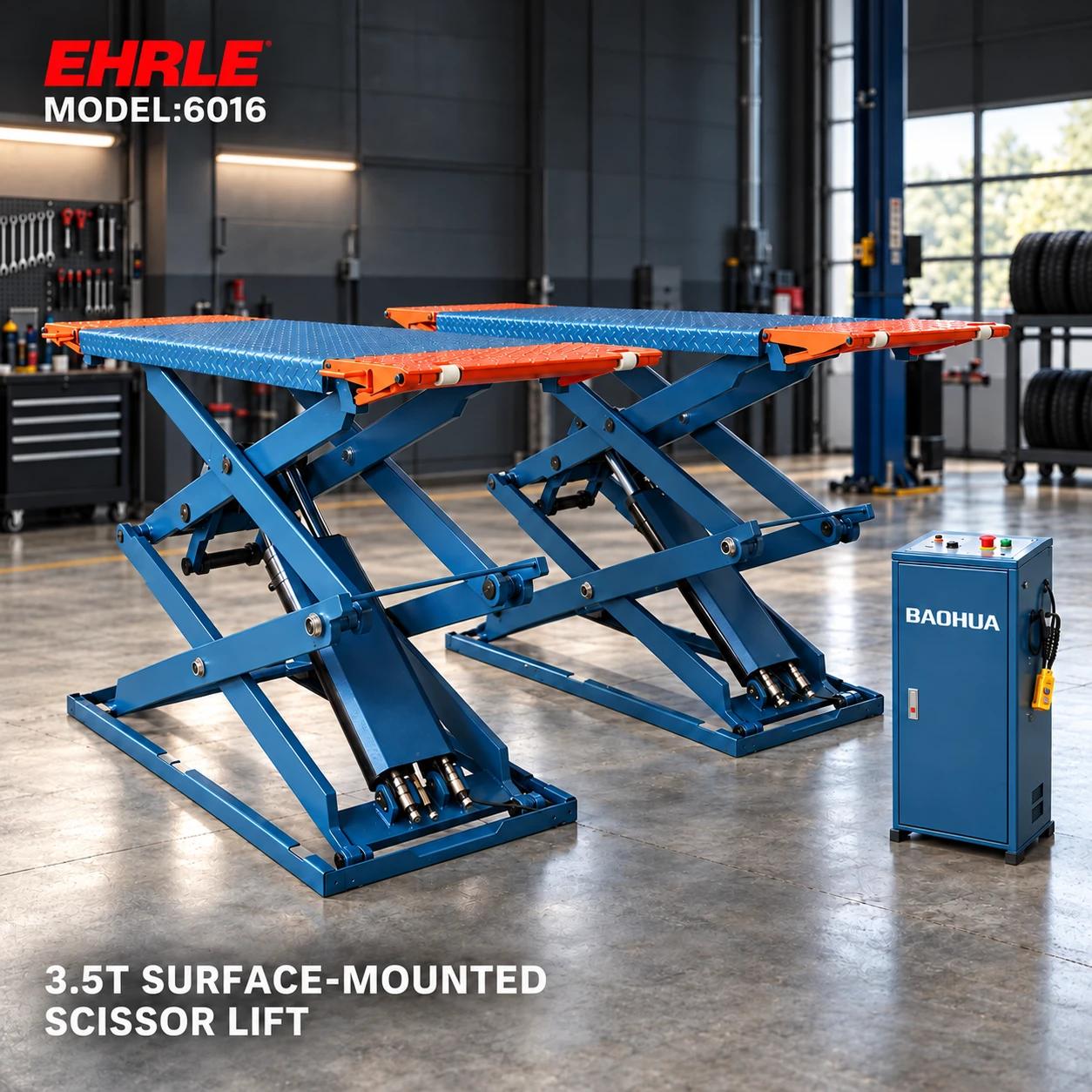
Product scene illustration. The current record lists 3,500 kg capacity; request numerical heights, platform dimensions and the pad package for the quoted version.