Can a Mobile or Portable Vehicle Lift Be Used Outdoors?
Use a lift outdoors only when the manufacturer’s documentation covers the exact equipment and site conditions. For fleet workshops and repair-shop buyers, mobility alone does not establish weather protection: BH-34T and 6010B/6010C illustrate the separate checks.
Key takeaways
• Mobile and portable describe movement; they do not establish outdoor suitability.
• Review exposure during operation, storage and charging separately.
• A canopy, paint finish or low control voltage cannot establish approval for the complete lift.
• Resolve the environment and the operating surface before treating a yard as another service bay.
1. Mobility and weather protection answer different questions
The ability to reposition a lift tells you how it can be moved under its instructions. It does not specify which rain, dust, temperature or other exposure the equipment can tolerate. A lift that fits through the workshop door has not thereby been approved for work beyond it.
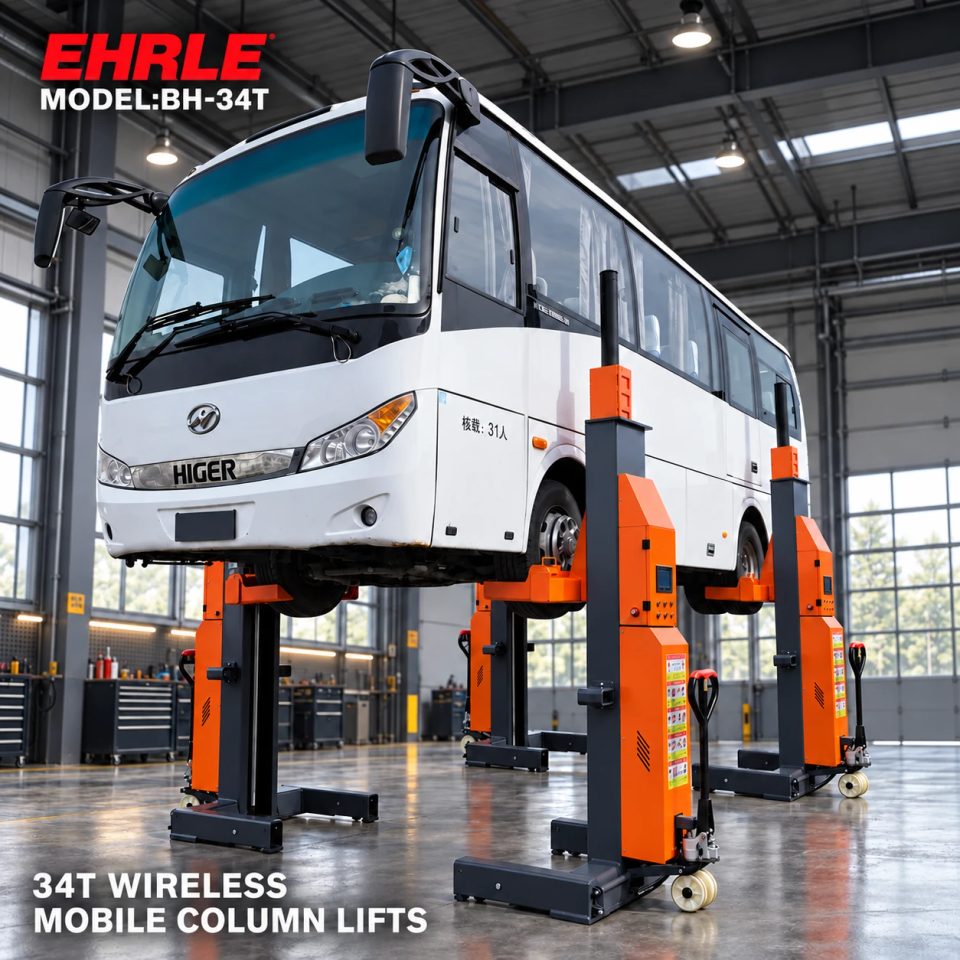
BH-34T uses mobile wheel-engaging columns. The listed transport wheels and trolley handle are for moving unloaded columns, not a raised vehicle. The 6010B/6010C record calls for confirming the removable mobility kit and moving the equipment only when unloaded and fully lowered. Those are movement provisions, not environmental ratings.
For an outdoor proposal, assess movement, vehicle fit and environmental suitability as separate requirements. Passing one does not resolve the other two.
2. Start with what the two EHRLE records actually establish
The standard BH-34T system comprises four columns rated at 8,500 kg each, with a combined rating of 34,000 kg. It lists rechargeable 24 V operation, AC 220 V charging and wireless communication. None of those entries establishes an ingress-protection rating, allowable weather exposure or an outdoor operating limit.
6010B is rated at 3,000 kg with 1,000 mm maximum lifting height; 6010C at 4,000 kg with 1,200 mm maximum height. Both use an electro-hydraulic arrangement, a listed 1.5 kW motor and 24 V controls. Electric lock release is standard; a pneumatic option requires order confirmation.
The current published records for these products do not establish outdoor approval or environmental limits. Treat outdoor suitability as unresolved until the manufacturer provides the applicable documentation for the actual supplied version. Capacity and lifting height remain useful selection facts, but cannot supply that missing approval.
3. Describe exposure across the equipment’s whole day
Specify where the lift operates, waits between jobs, is stored and, where applicable, is charged. Keeping a machine indoors overnight does not settle whether it may be used outside during the day; approval for one activity does not automatically cover the others.
For a hypothetical bus depot, describe whether BH-34T would work in an open yard or an open-sided shelter, whether driven rain or washing could reach it, and where its charging equipment would be located. Include the expected temperature range, dust and any coastal or chemical exposure in the supplier’s assessment.
For 6010B/6010C, include the separate operating equipment, electrical connections and any selected pneumatic equipment. Protecting one cabinet does not establish suitability of the lift assembly or its other components. Do not infer that 24 V controls make the entire installation weatherproof.
4. A canopy or a protective cover is not a universal conversion kit
A shelter changes some exposure conditions, but it does not itself change the lift’s documented intended environment. An open-sided canopy may still leave equipment exposed to wind-driven rain, condensation or airborne contaminants. The supplier needs the actual arrangement, not simply the word covered.
Stertil-Koni’s published Warwickshire Travel project describes its own outdoor mobile-column installation with specialised protective covers. That is a useful example of an explicitly specified outdoor arrangement. It does not establish that a similar-looking cover, another brand’s column or BH-34T has the same capability.
If environmental protection is proposed, establish whether it is manufacturer-approved, which equipment and activities it covers, and whether it is intended for use or storage. Do not fit an improvised enclosure that obstructs controls, inspection or required ventilation.
5. Review the outdoor surface and weather limits together
The equipment’s environmental suitability and the supporting surface are separate decisions. A yard that accommodates road vehicles is not automatically a suitable lift operating surface. Have the proposed support positions assessed against the exact lift’s floor and installation requirements.
For BH-34T, the assessment must address the actual column positions and concentrated support loads. For 6010B/6010C, review the specified platform support and operating arrangement. Do not copy slab thickness, anchoring details or permissible slope from another model.
Ask for any manufacturer-defined limits on wind and other operating conditions, including the response to changing weather and the conditions for resuming use. No wind-speed limit or outdoor stability approval for either EHRLE example is established here. A tall vehicle’s fit within the weight rating does not answer those questions.
6. Compare the complete site package before choosing the lift
The useful comparison is between documented equipment-and-site arrangements. An outdoor proposal may need a different approved configuration, protection, storage, charging location or maintenance scope. Those provisions belong in the quotation rather than in a verbal promise that the machine is mobile.
For a hypothetical workshop overflow bay, compare the proposed outdoor package with using the same service task in a suitable indoor bay. If outdoor approval is unavailable, keep the outdoor proposal unapproved; do not assume that occasional use or dry weather creates an exception.
Select the intended use first, then match the vehicle, lift configuration, environment and surface. This order avoids buying a portable machine and trying to establish its operating environment after delivery.
Your outdoor-use enquiry brief
Send the supplier:
1. Exact model, intended vehicle and service task.
2. Site photographs and a plan of operating, storage and charging locations.
3. Expected rain, washing, dust, temperature, wind and corrosive exposure.
4. Surface information and the proposed lift support positions.
5. Required protection, inspection, maintenance and weather-response provisions.
Request a written decision for the supplied configuration, its environmental limits and any separately priced equipment. Contact EHRLE with this brief to review BH-34T or 6010B/6010C requirements before committing an outdoor bay. The related pages below provide the verified product specifications, not outdoor-use approval.
Frequently asked questions
Does wireless operation mean BH-34T can be used in the rain?
No. Wireless communication describes a connection method. The current record does not establish rain exposure limits or outdoor suitability.
Can I make 6010B/6010C an outdoor lift by adding a cover?
A cover alone does not establish approval. The manufacturer must review the complete configuration, intended activity and exposure.
Is a 24 V control system proof that the lift is waterproof?
No. Control voltage and protection against environmental exposure are different specifications.
Does moving a lift back indoors after work resolve outdoor operation?
No. Operating and storage conditions require separate review. A suitable storage plan cannot authorize an otherwise unapproved operating environment.
Sources and image notes
Published, enabled and verified EHRLE BH-34T and 6010B/6010C records were checked on 2 November 2026. Product references are linked below. External primary reference: Stertil-Koni, Warwickshire Travel Chooses Stertil-Koni Column Lifts For Maintenance, dated 18 November 2024, at stertil-koni.co.uk. Its project concerns Stertil-Koni equipment; no protective feature, environmental rating or customer result is attributed to EHRLE.
Cover and gallery are indoor product scene illustrations, not verified customer installations, outdoor demonstrations or evidence of environmental protection. The scissor-lift illustration shows the 3T configuration. The bus-depot and overflow-bay examples are hypothetical.
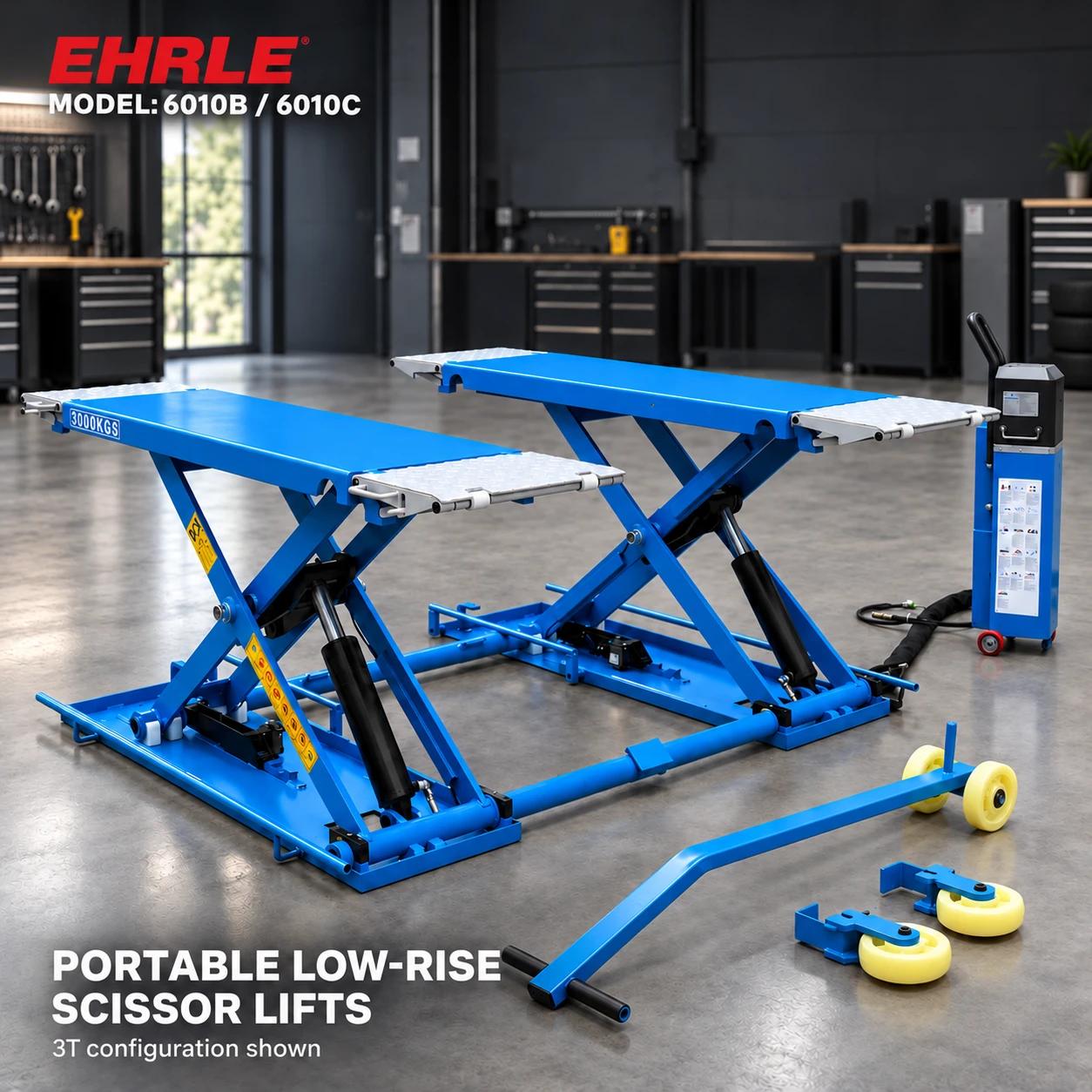
Indoor product scene illustration showing the 3T configuration. Confirm the supplied mobility kit and approved operating environment separately.