Short-Platform or Runway Scissor Lift? Match Vehicle Support to the Job
Use 6016 and BH6108 configurations to distinguish lifting-point support, tire-supported runways and secondary lifting when selecting a scissor lift.
Start with where the vehicle is supported
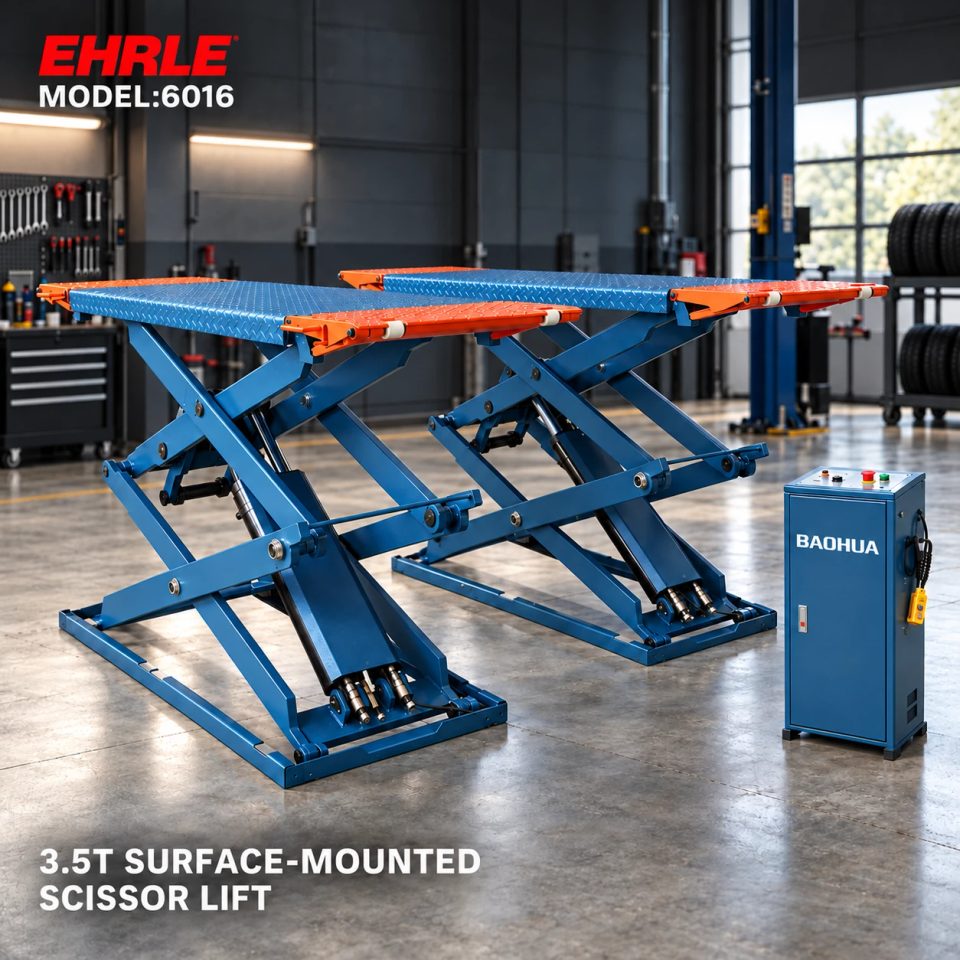
The EHRLE 6016 uses twin short platforms to support approved vehicle lifting points for wheel-free service. The BH6108 is a runway alignment lift: its main runways provide the tire-support layout, while a separate integrated secondary scissor stage serves compatible secondary lifting work. These arrangements answer different workshop needs.
Before comparing capacity, describe whether the intended job needs the vehicle resting on its wheels or requires wheel-free access. Then check the actual vehicle against the support arrangement and applicable operating documents. The word “scissor” describes a lift mechanism, not a universal method of supporting every vehicle.
6016: match the short platforms to the approved lifting points
The 6016 is listed as a 3,500 kg surface-mounted full-rise double-scissor lift with hinged platform ends. Its vehicle assessment needs the approved lifting points and the selected pad or adapter arrangement. Vehicle weight below the listed capacity is only one suitability check.
Obtain the platform dimensions and support-adapter package for the exact version, then have the supplier confirm the intended vehicles. The current specification does not provide verified numerical platform dimensions or maximum/minimum lifting heights. Do not replace these missing figures with another model’s data or use the illustration as a dimensioned support drawing.
BH6108: distinguish tire placement from secondary support positions
The BH6108 lists a 4,000 kg main capacity, 4,500 mm runway length and 630 mm width per runway. Its integrated secondary stage is rated at 3,000 kg, with a listed secondary platform length of 1,520–1,820 mm and lifting height of 500 mm.
The vehicle must suit both the intended runway arrangement and any secondary lifting arrangement used for the service task. Runway length is not a declared maximum vehicle wheelbase, and secondary platform length alone is not an approved lifting-point range. Request the usable support positions and applicable vehicle criteria from the selected configuration documents.
Let the task determine which support arrangement needs approval
For work intended to keep the vehicle supported on its tires, assess the runway layout and the selected alignment equipment together. The BH6108 record describes front turnplate positions and rear slip plates, but the actual supplied turnplates and any measuring equipment must be identified in the quotation.
For work needing wheel-free access, check the vehicle’s approved lifting points and the relevant pad, adapter and support geometry. On a BH6108, the main lift’s 4,000 kg rating must not be transferred to the 3,000 kg secondary stage. On a 6016, confirm the short-platform support package. Do not assume that either arrangement suits a particular vehicle simply because its total weight is within a headline rating.
Separate installation choice from vehicle-support choice
The 6016 is surface-mounted. The BH6108 uses an in-ground arrangement with two prepared pits. These differences affect the site plan, but they do not remove the need for vehicle-support compatibility checks. A suitable support arrangement still needs a suitable installation site.
Obtain the final factory drawing for the selected model before planning floor works. For the 6016, include the separate control cabinet, wired pendant and service routing in the layout. For the BH6108, use its configuration-specific foundation and pit documents. This comparison does not prescribe excavation dimensions, concrete or anchor values.
Ask for a vehicle-and-task confirmation, not a blanket category promise
Send representative vehicle models, operating weights, tire positions and approved lifting-point information. Describe the specific work: alignment, inspection or service requiring wheel-free access. Include any underbody features that affect access to the approved support points.
Ask the supplier to identify which arrangement is approved for each vehicle and task, and what adapters or secondary equipment are required. Broad labels such as “SUV” or “passenger car” do not supply those dimensions. A clear confirmation should refer to the actual model and supplied equipment rather than repeat only the lift’s capacity.
A quotation checklist for choosing the support layout
Request confirmation of:
1. Vehicle-support method for each intended service task.
2. Exact model and the main and secondary ratings where applicable.
3. Usable tire positions or lifting-point range for the supplied arrangement.
4. Platform dimensions and any missing pickup or lifting-height figures.
5. Pad, adapter, turnplate and measuring-equipment scope.
6. Model-specific floor layout, control position and service routes.
7. Electrical voltage, phase and frequency for the selected drive.
8. Installation and operating documents covering the proposed vehicle support.
Both current records list 220 V or 380 V supply choices and 24 V controls; phase and frequency require confirmation. These choices must be settled for the ordered unit. Send EHRLE the vehicle and task details with the site plan so the equipment scope can be reviewed together.
FAQ: Can a short-platform 6016 be treated as an alignment runway lift?
The current record does not list it as a long-runway alignment lift with turnplates. It describes short-platform support at approved vehicle lifting points. Review a dedicated runway model and its measuring-equipment compatibility for an alignment bay.
FAQ: Does the BH6108 main capacity establish its wheel-free capacity?
No. The main lift is rated at 4,000 kg and the integrated secondary stage at 3,000 kg. Assess the support loads and arrangement for the mechanism used.
FAQ: Does a published platform length prove that the lifting points will fit?
No. Confirm the actual support positions, adapters and vehicle lifting-point geometry using the selected configuration documentation. A length figure is not a universal fit approval.
Sources and image notes
This guide uses EHRLE 6016 and BH6108 product records checked on 14 October 2026. The related pages below provide the model information. The cover is a product scene illustration, not an approved support diagram or customer installation photograph. Confirm actual vehicle compatibility, supplied accessories and permitted operation in the model-specific documents.