Vehicle Lift Capacity: Actual Weight vs Curb Weight and GVWR
Use the vehicle’s actual intended lifting condition for capacity assessment, and keep brochure weights and maximum vehicle ratings distinct. For motorcycle and fleet-workshop buyers, BH-900 and BH-34T examples explain what weight evidence to provide and why total mass alone is insufficient.
Key takeaways
• A brochure weight, an actual measured weight and a vehicle weight rating are different information.
• Define the vehicle’s condition for lifting, including equipment and loads that remain aboard.
• Avoid adding the same fuel or equipment mass twice when using a published baseline.
• Total mass still does not establish support geometry or individual wheel-load suitability.
1. Identify what the published weight actually includes
Read the definition alongside the number. Curb or kerb weight is a specified vehicle baseline, not a measurement of every example that may arrive at the workshop. Dry weight is another label that must be checked against the vehicle maker’s stated conditions. Do not assume all markets and catalogues use identical inclusions.
Ford’s towing guidance distinguishes gross vehicle weight from gross vehicle weight rating: the former describes vehicle weight with actual carried loads, while the latter is a maximum design rating. Its Ranger Super Duty guidance also shows how a stated kerb-weight baseline excludes specified additions. These are vehicle-weight concepts, not lift approvals.
For procurement, record the exact variant and the source’s inclusions before using a brochure figure. A number with no condition attached leaves the supplier unable to tell whether installed options, fluids or carried equipment have already been counted.
2. Describe the vehicle as it will actually be lifted
The weight relevant to the lift assessment is the vehicle in its intended lifting condition. Record permanent accessories, fitted equipment and any cargo or luggage that will remain with it. A standard vehicle specification may not describe a modified or working vehicle.
For a hypothetical touring motorcycle, identify the fitted luggage system and other accessories rather than rely only on the base-bike listing. For a hypothetical fleet vehicle, identify service equipment or other retained loads and where they are carried. These examples are not claims about any particular customer or vehicle mass.
Do not add a full fuel load again if the baseline already includes it. Conversely, do not treat an excluded fluid or accessory as included without evidence. If the baseline cannot be reconciled to the actual configuration, obtain suitable weight evidence instead of using an uncertain addition as the final selection figure.
3. BH-900: distinguish motorcycle load from equipment weight
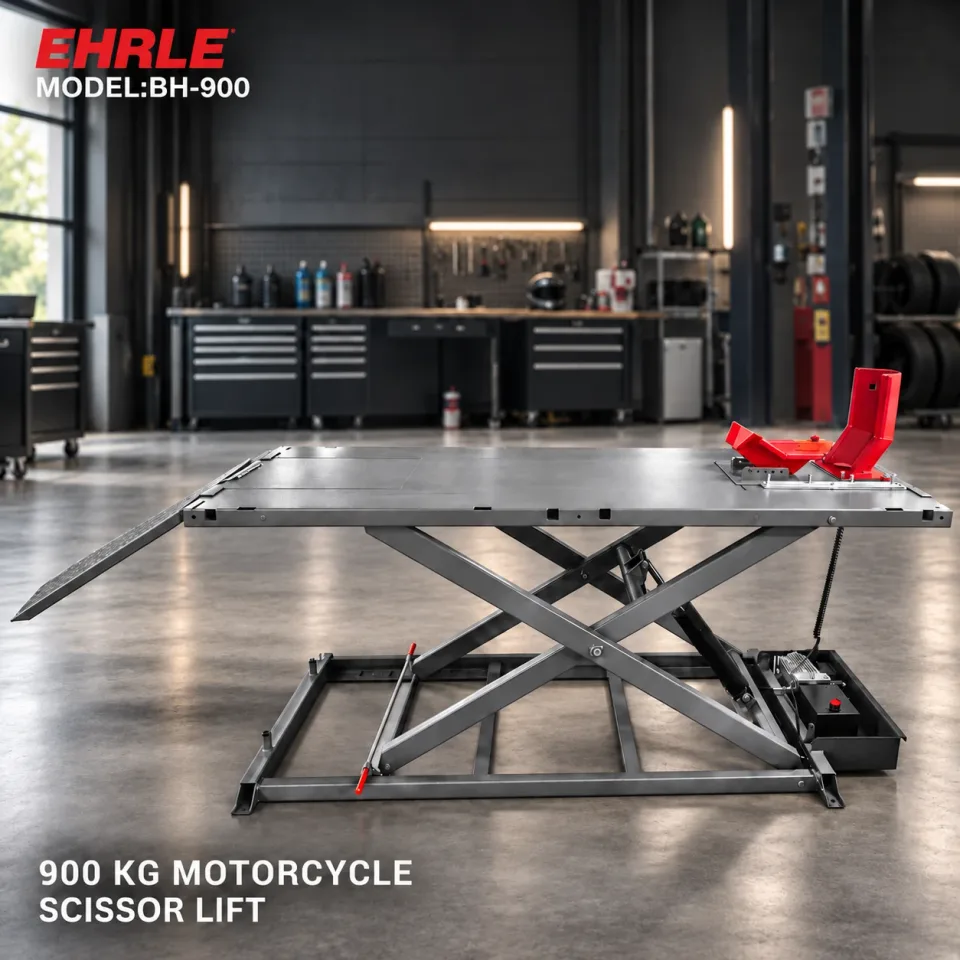
BH-900 is the narrow motorcycle lift table rated at 900 kg. Its working platform is 2,232 × 750 mm, and the equipment’s own listed weight is 248 kg. The 248 kg figure is not the motorcycle’s weight and should not be added to the 900 kg rating to create a larger vehicle allowance.
Compare the actual motorcycle and its retained loads with the applicable lift instructions, then review platform fit, wheel positions and securing arrangements. Being below 900 kg does not establish that the motorcycle fits the table or that the front wheel chock alone is a suitable restraint.
The listed widened 1,300 kg tricycle equipment is a separate version. Do not solve a mismatch by substituting that rating on a BH-900 order or treating an ATV or tricycle as an approved motorcycle-table application.
4. BH-34T: a valid total still needs valid support loads
BH-34T’s standard four-column set is rated at 34,000 kg combined, with an 8,500 kg rating for each column. An accurate total vehicle weight is necessary information, but dividing it by four does not establish the actual load at every supported wheel.
A retained load concentrated in one part of a vehicle can change the support-load distribution. Give the supplier the intended loading condition and appropriate individual support-load information for the proposed arrangement. An axle-total figure alone may not establish an equal left/right split.
The vehicle’s maximum rated mass is also not a measurement of its present wheel loads. Keep that rating as a separate limit and identification item. No permissible imbalance, weighing arrangement or new column configuration is established here; use the manufacturer’s approved review for the vehicle and lift set.
5. Use measurements and ratings for their different purposes
A suitable weight record should identify the vehicle, date, loading condition and what was measured. If the lift selection depends on individual support loads, make sure the evidence supplies that information rather than only a total. Agree the measurement method and its suitability with the qualified provider and lift supplier.
Ford’s Ranger Super Duty loading guidance recommends weighing before and after adding load to check its vehicle limits. This illustrates why a base specification may need measurement for a particular vehicle. It does not approve a Ford vehicle on BH-900, BH-34T or any other EHRLE lift.
Keep GVWR or the applicable maximum vehicle-mass rating alongside actual weight evidence, not in place of it. A measured condition can change when equipment or cargo changes. Record the intended range of workshop arrivals if the bay will serve several variants or load states.
6. Make the weight evidence part of a complete fit decision
Once the intended load is established, assess the correct support type and geometry, vehicle lifting points where applicable, accessories and load distribution. Reducing a load below a capacity label does not automatically resolve the other fit conditions.
BH-900 and BH-34T illustrate two different support systems: a motorcycle table and wheel-engaging columns for compatible heavy vehicles. Their ratings describe their own configurations, not interchangeable ways to support a vehicle. A road-going payload allowance is not extra lift capacity.
Follow the supplied vehicle and lift instructions for the actual work. References to passengers in road-weight definitions are not permission for people to remain on a vehicle during lifting. This guide is a purchasing framework, not an operating or unloading procedure.
Your vehicle-weight evidence checklist
Provide:
1. Vehicle make, exact variant and any relevant identification.
2. Published baseline weight, units and stated inclusions.
3. Installed options, modifications and retained loads in the lifting condition.
4. Suitable actual weight evidence, including individual support loads where required.
5. The applicable vehicle ratings, separately identified.
6. Lift configuration, support geometry and intended service task for compatibility review.
Contact EHRLE with this information to review BH-900 motorcycle-table or BH-34T mobile-column requirements. The useful result is a documented vehicle-and-lift match using the relevant load condition, rather than a capacity comparison based on an unexplained brochure number.
Frequently asked questions
Is curb weight always the weight of the vehicle arriving for service?
No. Check the vehicle maker’s definition and the actual vehicle’s options, modifications and retained loads.
Can I use GVWR as the measured vehicle weight?
No. It is a rating, not evidence of the present loading condition. It can help describe the intended vehicle envelope, but does not establish actual support loads.
Should I always add fuel to a published weight?
No. First check whether fuel is already included in that baseline and what the stated condition is. Avoid both omissions and double counting.
Can I divide vehicle weight by four to choose BH-34T columns?
That does not establish actual supported-wheel loads. Each column’s 8,500 kg rating must be respected in the approved arrangement.
Sources and image notes
Published, enabled and verified EHRLE BH-900 and BH-34T records were checked on 5 November 2026. Related pages are linked below. Primary references: Ford Canada, Ford Towing Guide, at ford.ca; Ford Australia, Ford Ranger Super Duty payload, at ford.com.au. These explain vehicle weight concepts and load measurement; their vehicle limits, definitions and towing procedures are not EHRLE lift specifications or approvals.
Cover and gallery are product scene illustrations, not weighing records or verified customer installations. The pictured bus does not establish its mass or individual wheel loads. The touring-motorcycle and fleet-loading examples are hypothetical. No universal safety-margin percentage or vehicle compatibility guarantee is supplied.
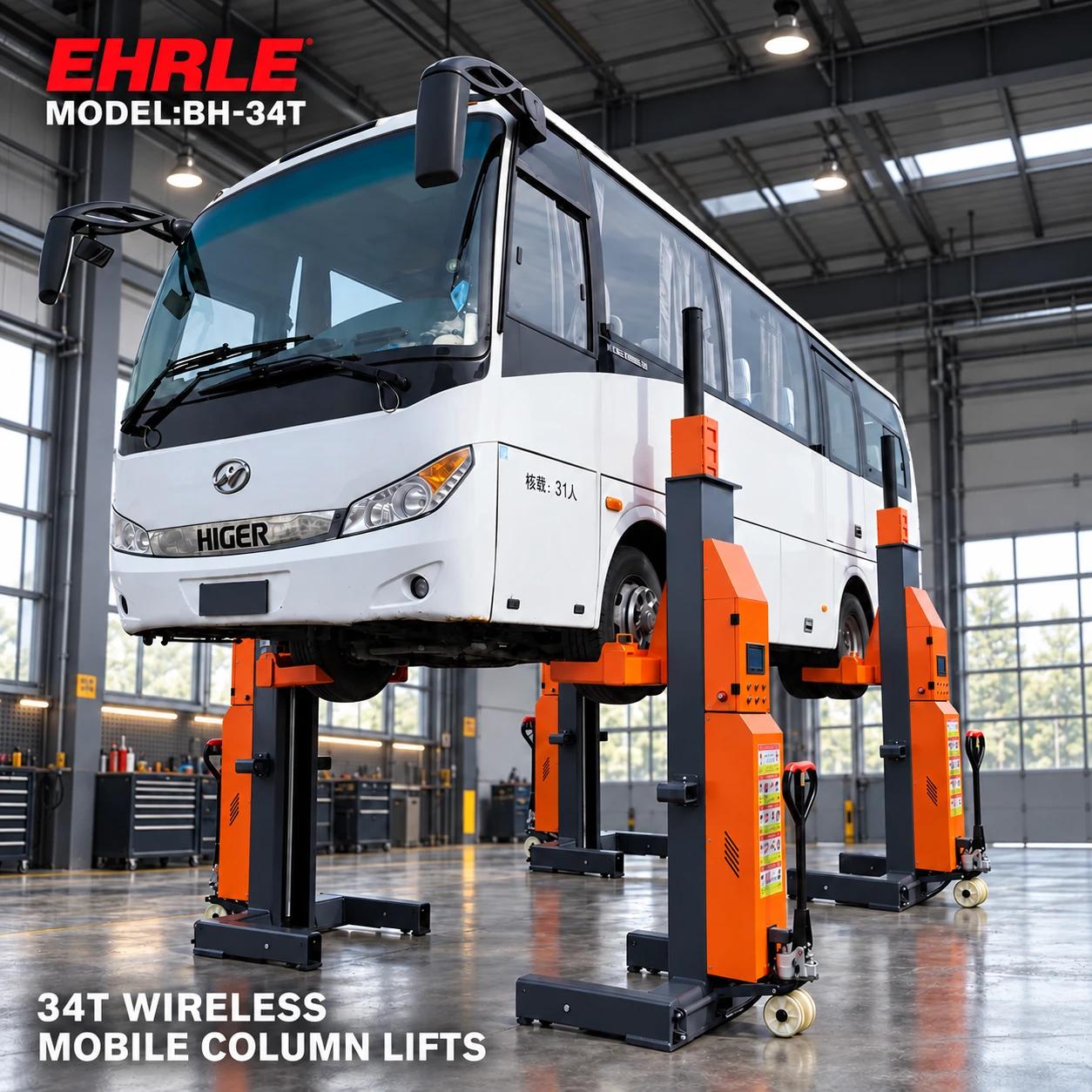
Product scene illustration. Four columns provide a combined 34,000 kg rating, with an 8,500 kg rating per column; the pictured vehicle does not establish a load measurement.