Vehicle Lift Maintenance Documents: What Buyers Should Request and Record
Use BH-34T and EC500 examples to request model-specific maintenance instructions and organize inspection, service and outstanding-action records for your workshop.
Make maintenance information part of the purchasing conversation
A lift quotation should identify more than capacity and dimensions. Ask for the operating and maintenance documentation applicable to the equipment being supplied, the responsibilities for service and inspection, and the records the workshop needs to retain.
The Automotive Lift Institute’s inspection guidance explains that inspection covers the relevant lift systems and manufacturer-specified points, and that the findings should be recorded in writing. That provides a useful basis for requesting a documented process. It does not establish EHRLE certification or replace the requirements of the destination market and supplied model.
Identify the delivered equipment before creating a service file
Create a workshop file that identifies the lift model, available serial identification, supplied configuration and applicable document revision. Keep installation and commissioning records with the operating and maintenance instructions, rather than relying on a generic catalogue description.
For a BH-34T set, ask the supplier how the individual columns and approved operating configuration should be identified in that file. For an EC500 bay, record the ordered power-unit version and supplied arm/adapter arrangement. This is a proposed documentation method, not a claim that every record has already been provided with the equipment.
BH-34T: ask for instructions covering the complete column system
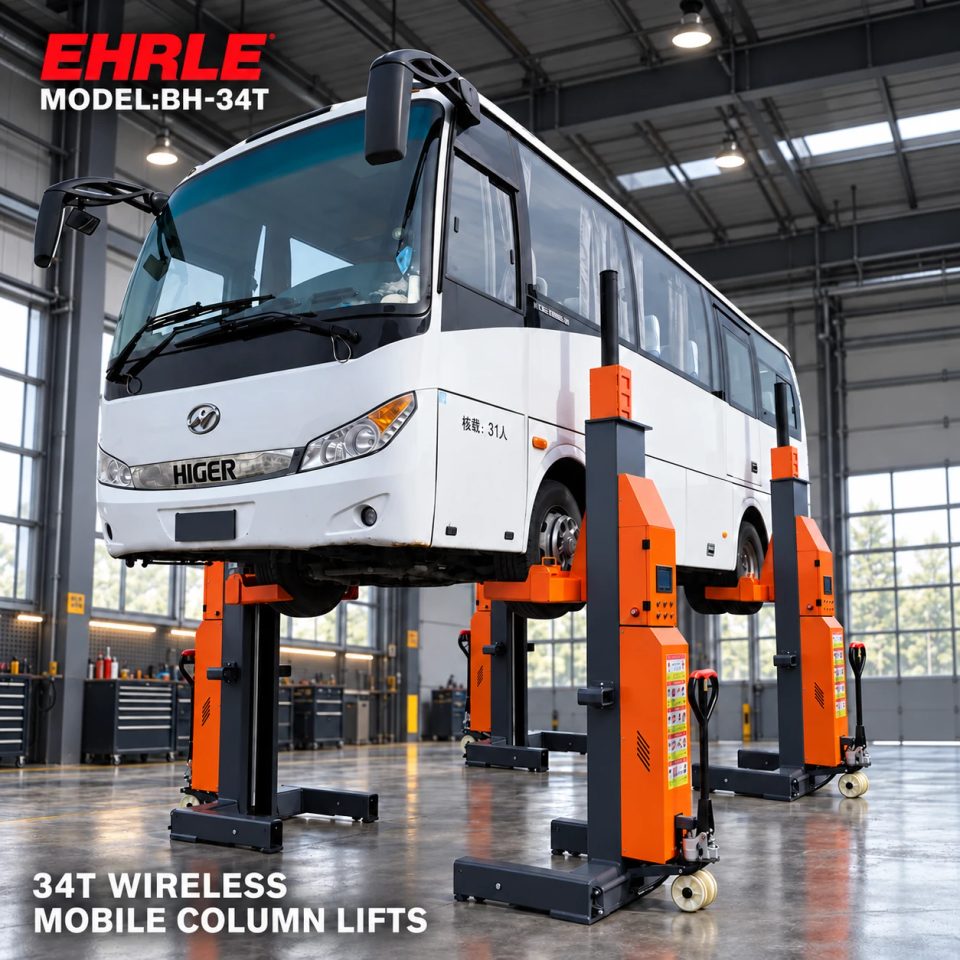
The current BH-34T record describes a standard four-column wheel-engaging hydraulic system, with 8,500 kg capacity per column and 34,000 kg combined rating. It lists rechargeable 24 V operation, AC 220 V charging and wireless communication. Six- or eight-column arrangements require an approved vehicle and control configuration.
Request the maintenance and inspection instructions for the exact columns, charging equipment and control arrangement supplied. Ask which tasks operators may perform and which require qualified service personnel. The current product record does not publish maintenance intervals, lubricant specifications or battery-service procedures; do not invent those values or copy them from another system.
EC500: a component description does not define whole-lift maintenance
The EC500 record lists automatic arm locking, single-side manual release, a hydraulic power unit and metal hydraulic pipes. Its steel cable description uses the wording “maintenance-free design.” That component description should not be treated as an instruction to omit inspection of the complete lift.
Ask the supplier to explain the scope of the cable description and provide the applicable inspection criteria for the supplied equipment. Obtain the model’s instructions for the locking, support and hydraulic systems rather than deriving service procedures from a feature list. The current product record alone does not establish an inspection checklist or maintenance schedule.
Separate operator observations, maintenance and formal inspection records
Use the applicable manual to establish what operators must check and how concerns should be reported. Keep those observations distinct from records of servicing and formal inspection, so it is clear who performed each activity and what document or requirement governed it.
For formal inspection, ALI’s published guidance calls for a written record of observations, findings, adjustments and replaced parts. Its discussion of ANSI/ALI inspection requirements is a North American reference, not a universal legal schedule for every export destination. Confirm the locally applicable requirements and the manufacturer’s instructions with the qualified provider before setting the workshop schedule.
A practical record structure to agree with the service provider
A workshop can use the following fields as a starting point, then adapt them to the applicable requirements:
1. Equipment and configuration identification.
2. Date, activity type and the person or service provider responsible.
3. Applicable manual, checklist or inspection document.
4. Observations and the identified issue.
5. Work performed, adjustments and parts replaced where applicable.
6. Outstanding actions and their responsible person.
7. Inspection result or documented service-status decision by the appropriate qualified party.
Do not turn a completed record into permission to perform repairs beyond the person’s competence or the manual’s scope. Agree how unresolved findings are handled and how the equipment’s permitted service status is determined under the applicable instructions.
Questions to resolve before delivery
Request the exact operating and maintenance manuals; manufacturer-defined inspection items and intervals; approved consumables and replacement-part identification where applicable; service responsibilities; training-document requirements; and the process for reporting faults. Ask whether the supplier provides a model-specific record template or whether the workshop’s qualified provider must prepare one.
Send EHRLE the selected model, configuration, destination and intended use so the document scope can be clarified with the quotation. For existing equipment, provide its identification and current documents rather than assuming a newer catalogue entry describes the installed version. This guide does not prescribe torque, oil, battery, test-load or repair procedures.
FAQ: Does “maintenance-free” on one component mean the lift needs no inspection?
Do not make that assumption. Confirm what the component description covers and follow the complete lift’s applicable maintenance and inspection instructions.
FAQ: Can one checklist cover a mobile-column set and a two-post lift?
A common record format may help organize information, but the technical checks must follow each supplied model and configuration. BH-34T and EC500 have different support and control arrangements.
FAQ: Can a catalogue page establish the maintenance interval?
Only if it provides the applicable verified requirement. The current records used here do not establish model-specific maintenance intervals. Obtain the supplied manual and confirm destination requirements with the qualified provider.
Sources and image notes
Product details: EHRLE BH-34T and EC500 records checked on 14 October 2026, linked below. General inspection-documentation reference: Automotive Lift Institute, Annual Lift Inspections Provide Peace of Mind, https://www.autolift.org/get-your-lift-inspected/ (consulted 14 October 2026). The reference supports written inspection records and manufacturer-specific inspection points; it does not certify these EHRLE models. The cover is a product scene illustration, not a customer inspection record or proof of vehicle compatibility.