Wireless Mobile Column Lift Controls: Specify the Set and Fault Response
For BH-34T procurement, confirm the approved column set, permitted modes, communication limits and documented fault response. A wireless label does not define these functions.
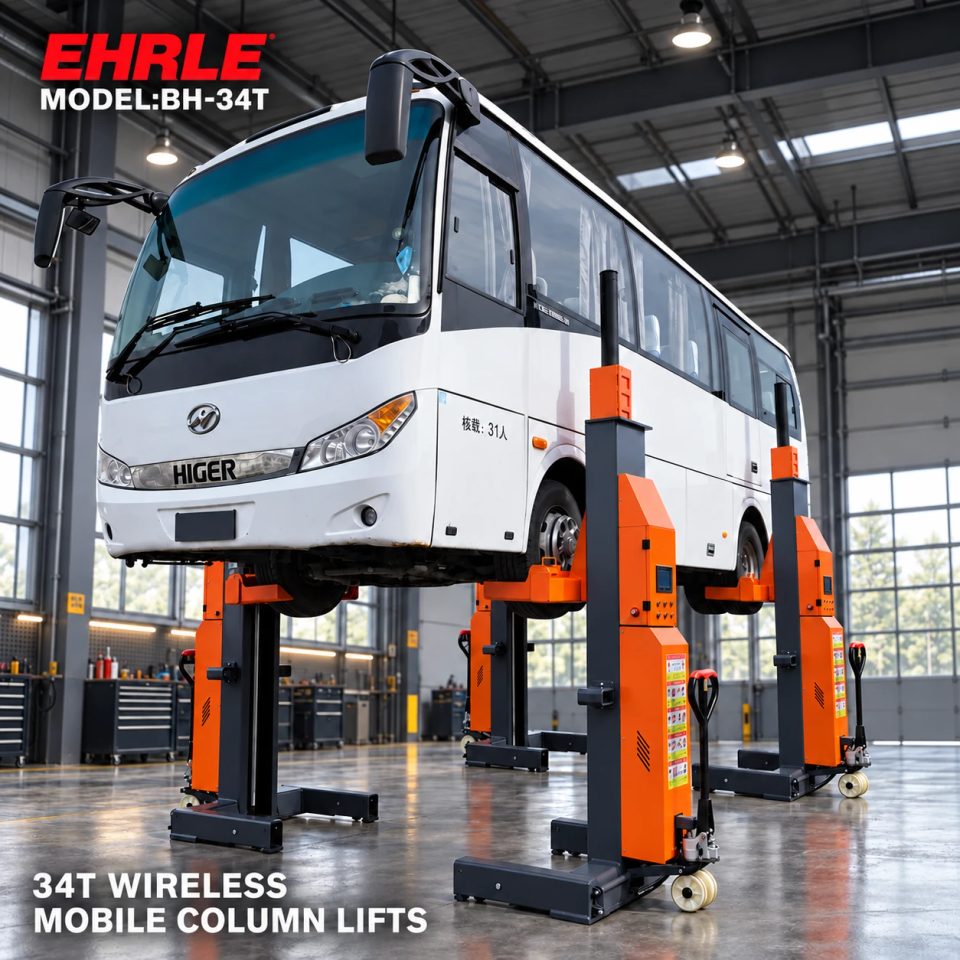
Buy an identified control configuration, not just a wireless label
For a fleet workshop, the word wireless is only the start of a mobile-column control specification. Buyers need to establish which columns belong to the approved set, which operating arrangements are permitted and what instructions cover a fault or interrupted communication. A catalogue label does not answer those questions.
This guide uses the EHRLE BH-34T to define the evidence to request before ordering. A separate 6016 wired-pendant example explains why control descriptions need their own model documents. It does not provide pairing, recovery or emergency-lowering instructions.
What the BH-34T record actually establishes
The verified record describes four wheel-engaging hydraulic columns as the standard set, rated at 8,500 kg per column and 34,000 kg combined. It lists rechargeable 24 V operation, AC 220 V charging and wireless communication. Six- and eight-column options require an approved vehicle and control configuration.
Those entries do not establish a particular radio protocol, operating distance, synchronization tolerance, controller revision or permission to combine columns from different sets. Keep these items as questions for the supplier rather than interpreting wireless as Wi-Fi, Bluetooth, a phone application or unrestricted remote operation.
Record set membership and permitted operating arrangements
Ask the supplier how the delivered columns and their approved set are identified, and how operators verify the intended configuration using the supplied instructions. For an order with six or eight columns, request documentation for that exact arrangement rather than relying on the standard four-column description.
Ask which coordinated operating modes, if any, are provided and which are permitted for the proposed vehicle and task. Do not assume individual-column or paired operation is allowed merely because controls appear on a column. An approved column count also does not replace assessment of the individual wheel loads, tire engagement and floor positions.
Make fault response part of the document request
Request the model-specific description of what the complete set does if communication is interrupted, a column is unavailable or a relevant control fault occurs. Ask what indications the operator will see, which actions the trained operator is permitted to take and when qualified service assistance is required. These are required clarifications, not statements that BH-34T has a particular undocumented fault-response feature.
Keep the recovery and return-to-service procedure with the correct control-version instructions. A power cycle or a procedure seen on another lift must not become an assumed recovery method. If emergency lowering is provided, obtain its authorized procedure, training scope and responsible personnel from the manufacturer. This guide gives no sequence for performing it.
Plan the operator position and nearby equipment together
Show the supplier the proposed vehicle positions and where operators expect to stand. Identify other mobile-column sets expected to operate nearby, if any. Ask for the permitted control location, visibility conditions, communication limits and any instructions for keeping separate sets correctly identified.
The current BH-34T record provides no numerical radio range or statement about simultaneous nearby systems. A successful demonstration at one workshop position does not establish unlimited range or immunity to interference at another. Request the applicable limits and an agreed commissioning assessment for the actual layout, performed under the supplied instructions.
6016: a wired pendant is a different control description
The 6016 is a 3,500 kg surface-mounted full-rise double-scissor lift with a separate cabinet, wired pendant and 24 V controls. That identifies a different operating-station arrangement from BH-34T wireless communication. It does not supply a complete synchronization or fault-response specification.
For 6016, obtain the cabinet and pendant documents, control functions, cable reach and prescribed fault instructions. For BH-34T, obtain the approved column-set and wireless-control documents. The shared 24 V wording does not make their controls interchangeable. Neither control arrangement makes these lifts substitutes for the same vehicles or service tasks.
Agree a documented handover rather than an improvised fault test
Request identification of the supplied control version, an explanation of permitted modes and a manufacturer-defined commissioning checklist. Agree what the qualified installer will demonstrate and record, including the meaning of normal and fault indications and the process for obtaining technical assistance. Do not create faults or interrupt a loaded system to test an undocumented response.
The Automotive Lift Institute’s guidance on safe lift use calls for checks of controls, synchronizing systems and locking devices under the applicable instructions, along with training on the particular lift. That supports asking for model-specific checks and training; it does not establish BH-34T certification or any numerical control-performance limit.
A quotation checklist for mobile-column controls
Request:
1. Exact column count, equipment identities and supplied control version.
2. Written scope of the approved vehicle and operating configuration.
3. Permitted modes and the documented method for identifying the intended set.
4. Communication limits and operator-position requirements for the proposed workshop.
5. Manufacturer-defined fault indications, response and recovery responsibilities.
6. Applicable emergency procedure and training scope, where provided.
7. Commissioning records, operator training and technical-support documents.
Contact EHRLE with your fleet, intended BH-34T column arrangement and workshop layout to clarify this control-document pack. If a required function is not documented, keep it open in the quotation review instead of promising it from the wireless label alone.
FAQ: Can spare BH-34T columns automatically join an existing set?
The current product record does not establish that capability. Identify the existing equipment and control version, and obtain manufacturer approval for the proposed combination before treating extra columns as an extension of the set.
FAQ: Does wireless mean a smartphone can operate the lift?
No such phone-control function is established by the current record. Wireless describes communication; request the exact supplied controls and operating instructions.
FAQ: What should an operator do after a communication fault?
Use the exact model and control-version fault instructions and the trained response process. The available catalogue does not supply a recovery sequence, and this article cannot authorize a reset, bypass or emergency lowering.
Sources and image notes
Published, enabled and verified EHRLE BH-34T and 6016 records were checked on 26 October 2026. Related pages are linked below. General reference: Automotive Lift Institute, How to Safely Use a Car Lift or Truck Lift, at autolift.org, consulted the same day. The reference supports model-specific control checks and operator training only; it supplies no BH-34T radio or synchronization specification.
The cover and gallery are product scene illustrations. The BH-34T bus scene is not a verified customer installation, pairing demonstration or proof of fault response. The 6016 scene does not establish cable length or control internals. This guide adds set identification, permitted modes and fault-response documentation beyond earlier voltage, charging and replacement-parts discussions.
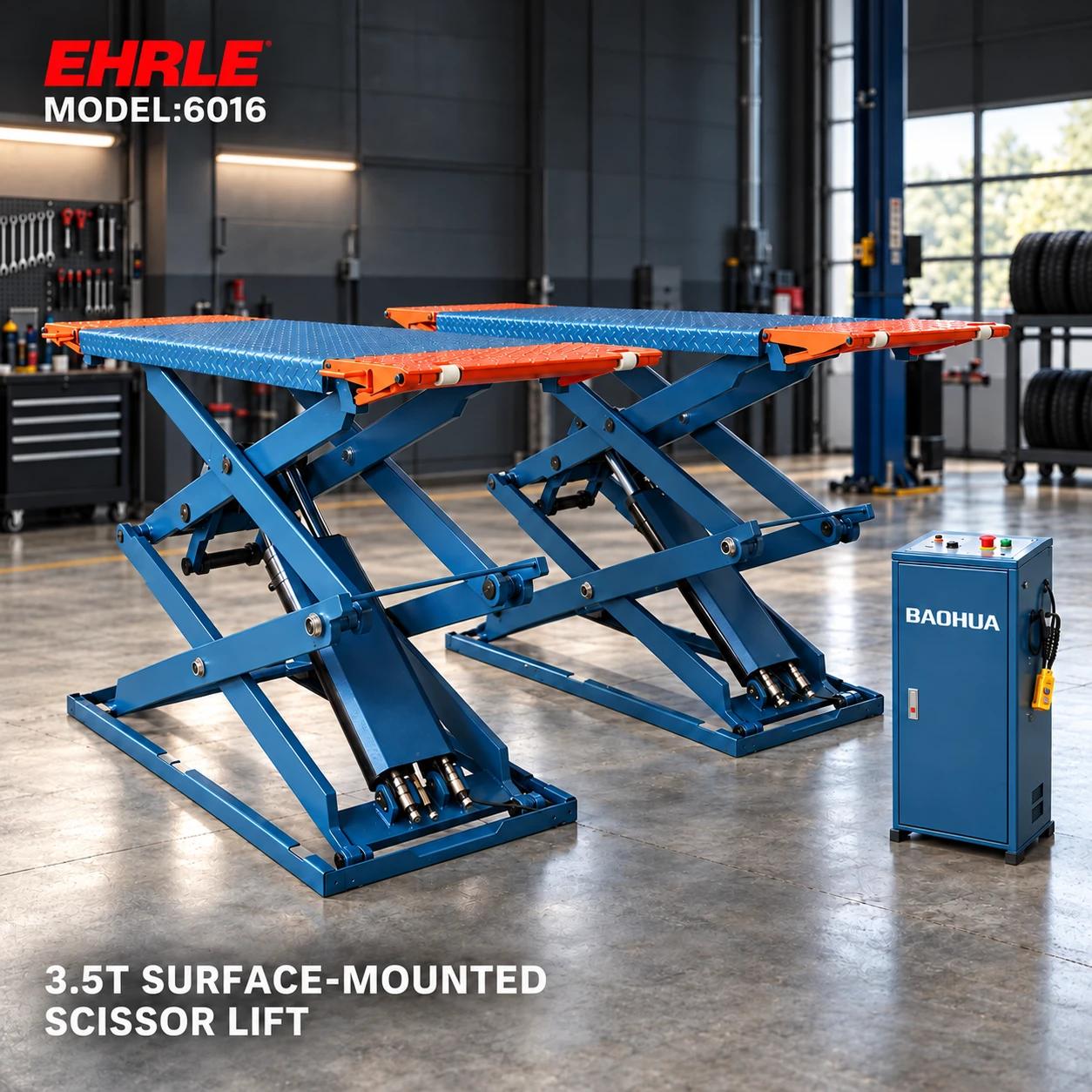
Product scene illustration. The cabinet and pendant arrangement is distinct from BH-34T wireless communication; shared 24 V wording does not establish interchangeable controls.